
Menu
The assumption that hearing loss belongs to people in their eighties is one of the most persistent and most expensive myths in Australian health care. Expensive, because it keeps people out of a testing room for an average of several years after they first notice a problem, and hearing that is not assessed cannot be supported.
Plenty of the people who should be booking a hearing test are nowhere near retirement. They are tradies who have spent fifteen years around grinders and nail guns on Coomera’s construction sites. They are hospitality workers, musicians, mechanics, and parents in their thirties who cannot follow the conversation in a noisy cafe on Foxwell Road but hear perfectly well at home. They are children who seem inattentive at school when the real issue is that they are missing consonants.
This article covers what causes hearing changes at any age, the signs that are easy to dismiss, what a hearing assessment actually involves, what it costs, and when it is worth getting checked. Cost is worth flagging early, because free hearing checks are available for eligible patients including pensioners and Department of Veterans’ Affairs card holders under the Australian Government Hearing Services Program, and a good number of people who qualify have no idea that they do.
Age-related hearing change is real, and it is common. It is also only one pathway among several.
Noise exposure is the big one, and it is cumulative rather than dramatic. You do not need a single deafening incident. Years of regular exposure to power tools, machinery, heavy vehicles, live music or firearms does the damage gradually, and the damage is permanent. This matters in a region like the northern Gold Coast, where a large share of the working population is in construction, trades, transport and manufacturing.
Ear wax is far more common than people expect and is completely reversible. A blocked ear canal can produce a genuine and sometimes sudden drop in hearing, along with a feeling of fullness or pressure.
Middle ear problems, including fluid behind the eardrum and repeated ear infections, are a frequent cause of temporary hearing loss in children and can affect speech and learning if they persist.
Medications and medical conditions can also play a part. Some medicines are known to affect hearing, and conditions including diabetes and cardiovascular disease have associations with hearing change.
Tinnitus, the ringing, buzzing or hissing that many people experience, is not itself a disease but is often the first noticeable sign that something in the hearing system has changed. It is worth investigating rather than tolerating.
Healthdirect provides plain-language Australian information on causes of hearing loss at healthdirect.gov.au.
Hearing rarely disappears. It degrades selectively, which is why it is so easy to explain away. High-frequency sounds usually go first, which means consonants such as s, f, th and t become indistinct while vowels stay clear. Speech still sounds present. It just stops making sense.
The everyday signs worth taking seriously include:
That last one deserves particular weight. Because hearing change is gradual, the person experiencing it is usually the last to notice. The household notices first.
For children, the signs are different: sitting close to the screen, not responding when called from another room, delayed or unclear speech, mishearing instructions, or a teacher raising concerns about attention and listening.
For anyone imagining something uncomfortable, a hearing assessment is straightforward, painless and non-invasive.
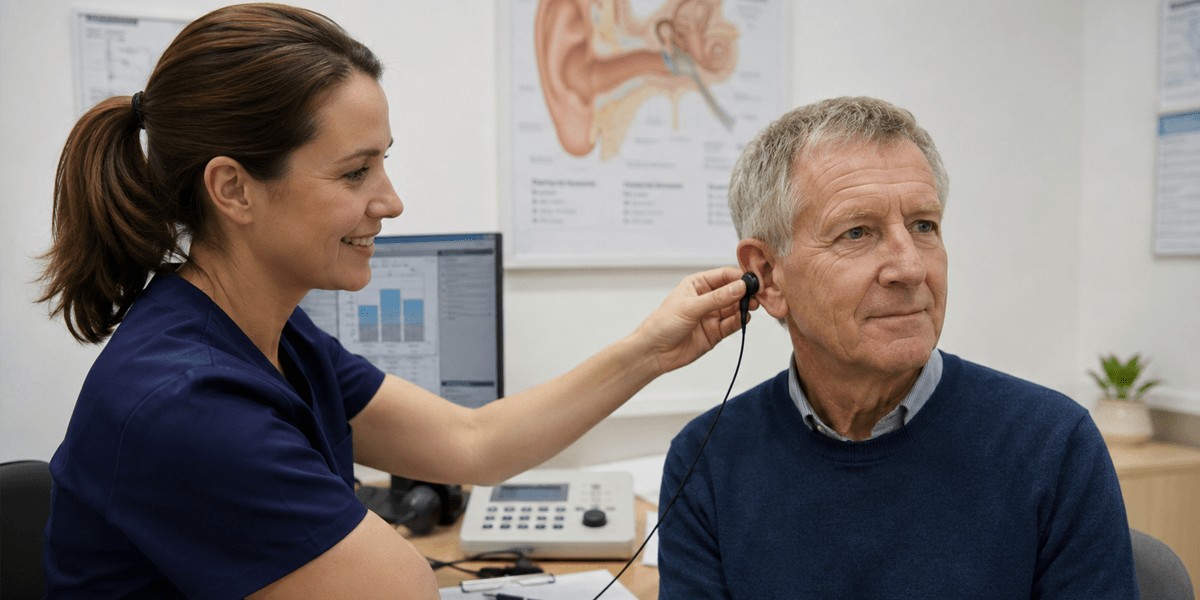
The audiologist starts with a conversation about your hearing history, your noise exposure, any tinnitus, any ear infections or surgery, and what specifically prompted you to come in. Then your ears are examined, which also identifies wax or any visible issue with the eardrum.
The core of the assessment is usually pure tone audiometry. You sit with headphones on and respond to tones presented at different pitches and volumes, which maps the softest sound you can detect across the frequency range. The results are plotted on a graph called an audiogram, which shows both the degree of any hearing loss and the type, meaning whether the issue sits in the outer or middle ear, the inner ear, or both. That distinction matters because it determines what can be done about it.
At Doctors at Coomera Central, audiology services include comprehensive hearing assessments for adults and children aged 5 and over, hearing aid fitting, servicing and troubleshooting, assistive listening devices, pre-employment hearing checks, tinnitus assessment and counselling, and ear wax removal by microsuction. Assessments are provided by Julia, an accredited audiologist with a Master of Audiology Studies and a member of Audiology Australia.
An assessment usually takes around 30 to 60 minutes. Your audiologist will explain your audiogram in plain terms and talk through what your options are, if any are needed.
Untreated hearing change does not stay contained to the ears. People withdraw from group settings because the effort is exhausting. Conversations shorten. Social contact narrows. There is a growing body of Australian and international research examining the links between unaddressed hearing loss and reduced wellbeing, social isolation and cognitive decline in later life.
There is also a workplace dimension. If your hearing is part of how you do your job safely, a baseline assessment is useful evidence to have on record, and pre-employment hearing checks are available for exactly this reason.
Free hearing checks may be available for eligible patients, including pensioners and Department of Veterans’ Affairs card holders, under the Australian Government Hearing Services Program. Eligibility criteria are set out at hearingservices.gov.au. Other assessments and services may involve a fee, so it is worth asking reception about your eligibility and current costs when you book.
It is worth being clear about the difference between two things that often get confused. Audiology assessments are funded through the Hearing Services Program for eligible patients, not through Medicare bulk billing. GP consultations at Doctors at Coomera Central are a separate matter, and are bulk billed for concession and pension card holders, Aboriginal and Torres Strait Islander patients, and Department of Veterans’ Affairs card holders with a valid Medicare card. So if you would rather start by talking to a GP about your hearing before booking an audiology assessment, that first conversation may cost you nothing.
A referral is generally not needed for a standard hearing check. Some funded or specialist services do require one, and your GP can arrange that. If a hearing change turns out to be part of a broader picture, our GPs can also review it alongside our geriatric care and children’s health services.
The clinic is on Coomera Grand Drive, Upper Coomera, next to ALDI, with ground floor rooms, wheelchair access and on-site parking, and is open seven days a week from 8:00am to 5:00pm.
If someone in your household has mentioned your hearing more than once, that is reason enough to get it checked, and if you hold a pension or DVA card the check may be free. You can read more about our hearing test and audiology services, book an appointment online, or call the practice on (07) 5638 5315.